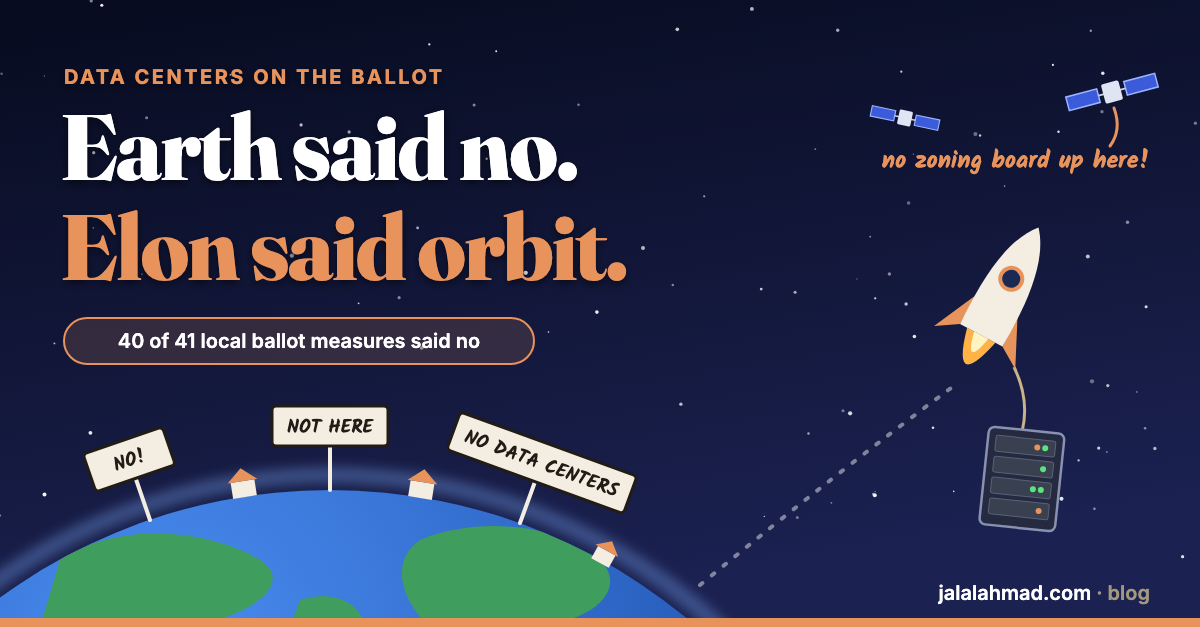
On Tuesday, American voters were asked the same question 41 times in 10 states: Do you want an AI data center here?
They said no 40 times. The 41st wasn’t exactly a yes, either.
By Wednesday, the man with the most rockets on the planet had a reply ready. Elon Musk, posting on X and quoted by CNBC: Data centers in space looking pretty appealing right now.
It’s a funny line. It’s also the most honest summary of where the artificial intelligence (AI) industry now stands: it can buy the chips, it can buy the power plants, and it apparently can’t buy the neighbors.
The Scoreboard From Tuesday Night
Ballotpedia, the nonpartisan election encyclopedia, counted 41 local ballot measures about data centers across 10 states in the 3 November 2026 midterms. According to CNBC’s reporting on that count, voters sided against data centers in every single one except one.
The results were lopsided almost everywhere they were counted:
| Where | What Was on the Ballot | What Happened |
|---|---|---|
| Ohio | 21 measures, the most of any state, including bans on data centers drawing more than 25 megawatts in Conneaut, Defiance, Oregon and Sunbury, and outright bans in Granville, Hubbard, Urbana, Upper Sandusky and Piqua | Every one went against data centers |
| Illinois | 7 measures: moratoriums, restrictions and advisory questions | All 7 went against data center development |
| Wisconsin | A rule requiring voter approval for any development costing more than $450 million | Passed |
| New Jersey | An advisory question in one community backing data centers | Voted down |
| Harwood, North Dakota | An added review step for industrial projects, including data centers | Rejected, the lone exception |
Not every tracker counts the same way. Tom’s Hardware put the total at 45 measures, depending on what counts as “about data centers.” Every count points the same direction, though. In a CNBC Voter Poll, 56% of voters said data centers were a “crucial or major factor” in their decision, with Democrats ranking the issue higher than Republicans.
Read that again: data centers, the warehouses full of computers that most people never think about, were a major factor for most voters in a national election.
Wall Street Noticed Too
On Thursday, 5 November, the markets had their own vote. According to CBS News, the Nasdaq Composite fell 5.5%, the S&P 500 fell 4.4%, and the Dow dropped 1,833 points. CNBC reported Nvidia down 9.3%, AMD (Advanced Micro Devices) down 17.3%, Micron down 17.5% and CoreWeave, which rents out AI computing, down about 10%.
To be fair to the facts: analysts mainly blamed Democrats winning control of Congress, and the regulation that might follow, plus an AI trade already strained by high interest rates and huge spending. But the data center question sat right in the middle of that fear. Capital Economics put it plainly: investors worried Democrats “will seek to regulate the AI industry and restrict data center development.”
Barclays credit strategist Dominique Toublan gave the week its slogan: The AI race shifts from a prisoner’s dilemma to a war of attrition: scarce power favors the biggest balance sheets.
The ripple reached the biggest AI listing on the calendar. On Kalshi, a prediction market, the odds that Anthropic announces its initial public offering (IPO) before December fell from nearly 90% to 57% in a week.
None of this came out of nowhere. CNBC cites the International Data Center Authority’s count of at least 46 AI data center projects in 20 states, representing more than $170 billion in announced investment, that were blocked, withdrawn or stalled between January 2024 and May 2026. Tuesday just put that trend on the ballot.
Plan B: Just Leave the Planet
Which brings us back to Elon.
The orbit idea isn’t a joke he made up on Wednesday. In January 2026, SpaceX asked the Federal Communications Commission (FCC) to approve a constellation of up to one million satellites as the foundation for an orbital AI data center. Musk has said space-based, solar-powered data centers will be cheaper than ones on the ground in as little as two to three years:
Increasing power on Earth becomes harder over time and more expensive over time, but in space it becomes actually cheaper and easier over time.
And you can see the appeal. Low Earth orbit has free sunshine around the clock, no water rights to fight over, and, crucially, no zoning board. Nobody in orbit has ever shown up to a township meeting with a petition and a folding chair. In space, no one can hear your cooling fans.
Before anyone sells their house to buy rocket stock, though, the people who study this for a living are less sure. Jeff Bezos, who runs a rocket company of his own, told CNBC that two-to-three-year timelines are probably a little ambitious.
Harvard economist Mark Weinzierl put it more bluntly: I haven’t seen any that say that right now [they’re] cost-competitive.
Even the optimists, like Bullpen Capital’s Duncan Davidson, call the economics “marginal” for now.
So, for the moment, orbit is the most expensive way ever invented to avoid a public hearing.
The Real Bottleneck Is No Longer the Chip
For three years, the AI story has been about scarcity: not enough graphics processing units (GPUs), not enough power, not enough grid. Tuesday added a new item to that list, and it is the one money can’t simply buy: local consent.
It’s tempting to read the results as voters being anti-technology. The polling says something more specific. Here in New Jersey, a Stockton University poll in April found that:
- 56% of voters would support banning data centers in their own town, against 22% opposed.
- 81% are concerned about how data centers could affect electricity prices, including 54% who are very concerned.
- 72% oppose tax breaks or subsidies for them.
- 84% support requiring data centers to supply their own new power.
That’s not people rejecting the future. That’s people reading the deal and noticing that they get the electric bill, the noise and the land use, while the company gets the tax break. Pemberton, in Burlington County, had already approved a local ban earlier this year, before any of this hit the ballot.
The industry has long treated local approval as paperwork: a box to tick after the land is bought and the power contract is signed. On Tuesday, the paperwork voted back.
The good news is that the fix is almost boringly down to earth. Pay for your own power instead of passing it to the neighbors. Skip the subsidy the town didn’t ask for. Show up before the deal is done, not after. None of that requires a rocket.
The Bottom Line
Elon may well be right that one day the cheapest place to run AI will be above our heads. Until then, the cheapest place to build a data center is still the place where the neighbors said yes.
That place is still on Earth. You just have to ask nicely and pay the electric bill.
Sources and References
- CNBC (4 November 2026): Voters rebuff data centers in every ballot measure except one, the Ballotpedia count of 41 measures in 10 states, the Harwood exception, the CNBC Voter Poll (56%), and Elon Musk’s post on X.
- Ballotpedia: Data center-related ballot measures, 2026, the underlying tracker.
- Newsweek: Map shows how data center measures fared across 10 states, the Ohio, Illinois, Wisconsin and New Jersey details in the table.
- Futurism (5 November 2026): Voters supported every single anti-data center proposal in America, except one.
- Tom’s Hardware: AI data centers comprehensively defeated at US midterm elections, the alternative count of 45 measures.
- CNBC (6 November 2026): AI stocks hammered by midterm shock as data center buildout becomes a ‘war of attrition’, individual stock moves, the Barclays quote and the International Data Center Authority figure.
- CBS News via Yahoo Finance (6 November 2026): Stocks crater as midterms spur investor exodus from tech and AI, index moves and the Capital Economics quote.
- CNBC (6 November 2026): Anthropic IPO announcement odds drop on Kalshi following midterms and AI sell-off.
- CNBC (21 June 2026): No one wants AI data centers on Earth. Do they make sense in space?, the SpaceX filing with the FCC, Musk’s timeline and quote, and the Bezos, Weinzierl and Davidson comments.
- NJBIZ (7 May 2026): Stockton poll: 56% back local bans on AI data centers, the Stockton Polling Institute survey of 642 registered New Jersey voters, 21–27 April 2026, margin of error ±3.9 points, and the Pemberton ban.
Market figures are from 5 and 6 November reporting, and some local results were still being counted at the time. Final certified totals may differ slightly.